Begin of page section:
Page sections:

  • Go to contents (Accesskey 1)
  • Go to position marker (Accesskey 2)
  • Go to main navigation (Accesskey 3)
  • Go to sub navigation (Accesskey 4)
  • Go to additional information (Accesskey 5)
  • Go to page settings (user/language) (Accesskey 8)
  • Go to search (Accesskey 9)

End of this page section. Go to overview of page sections

Begin of page section:
Page settings:

English en
Deutsch de
Search
Login

End of this page section. Go to overview of page sections

Begin of page section:
Search:

Search for details about Uni Graz
Close

End of this page section. Go to overview of page sections


Search

Begin of page section:
Main navigation:

Page navigation:

  • University

    University
    • About the University
    • Organisation
    • Faculties
    • Library
    • Working at University of Graz
    • Campus
    Developing solutions for the world of tomorrow - that is our mission. Our students and our researchers take on the great challenges of society and carry the knowledge out.
  • Research Profile

    Research Profile
    • Our Expertise
    • Research Questions
    • Research Portal
    • Promoting Research
    • Research Transfer
    • Ethics in Research
    • Commission for Scientific Integrity
    Scientific excellence and the courage to break new ground. Research at the University of Graz creates the foundations for making the future worth living.
  • Studies

    Studies
    • Prospective Students
    • Students
    • Registration for Study Programme (Winter semester 2026/27)
    • Study Days 22-26 June 2026
  • Community

    Community
    • International
    • Location
    • Research and Business
    • Alumni
    The University of Graz is a hub for international research and brings together scientists and business experts. Moreover, it fosters the exchange and cooperation in study and teaching.
Topics
  • Sustainable University
  • Researchers answer
  • Work for us
Close menu

End of this page section. Go to overview of page sections

Begin of page section:
You are here:

University of Graz Faculty of Law News Eurovision: Warum der Song Contest immer politisch ist
  • About the Faculty
  • Our Research
  • Student Services
  • Stay Connected

End of this page section. Go to overview of page sections

Monday, 04 May 2026

Eurovision: Why the Song Contest is always political

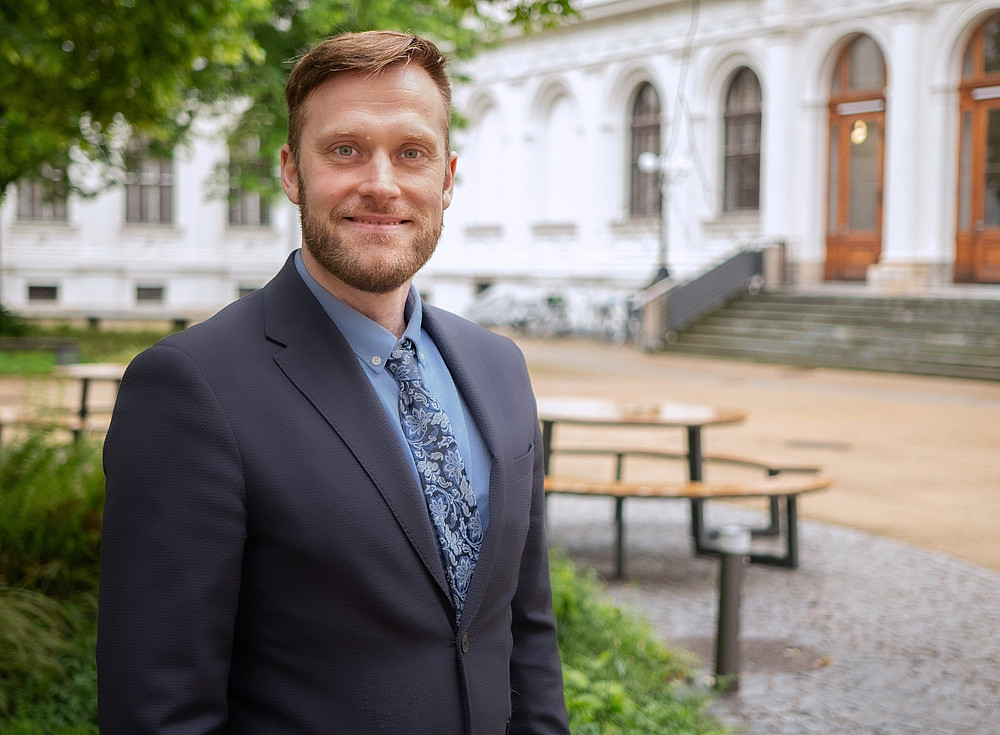
Person in a suit and a patterned tie is standing in a courtyard with benches and green spaces in front of a historic building with arcades. ©Uni Graz/Radlinger

Peace researcher Josef Mühlbauer. Photo: University of Graz/Radlinger

The 2026 Eurovision Song Contest sits at the intersection of music, geopolitics and culture. Josef Mühlbauer from the University of Graz explains why the ESC has always been a reflection of European politics, and how this major event highlights cultural affinities and social change.

From 12 to 16 May, millions of people will be tuning in to the Eurovision Song Contest (ESC). Whether on a mobile phone, a laptop or on the telly: the ESC is THE music event of the year. This makes the song contest one of the most significant cross-border and cross-cultural events. The organisers emphasise that the ESC is all about music, never about politics.

Yet this year, the contest is facing particular criticism: because Israel is taking part despite the Gaza war, Ireland, Iceland, the Netherlands, Slovenia and Spain are boycotting the contest. Can the claim of being ‘apolitical’ still be upheld? ‘Not really,’ says peace researcher Josef Mühlbauer from the Institute for Legal Foundations at the University of Graz.

“The Eurovision Song Contest is actually always a reflection of the current political situation in Europe,” explains the researcher. Political conflicts and cultural affinity have shaped the contest from the very beginning. For instance, a Scandinavian and a Balkan bloc are discernible. “But that has nothing to do with nationalism. Countries often award points to one another if they are culturally, geographically or aesthetically close,” says Mühlbauer. Large immigrant groups also influence voting behaviour in the countries.

Politics sings along

And time and again, political conflicts have played a part in the contest, be it the Cold War, the violent break-up of Yugoslavia or, most recently, Russia’s war of aggression in Ukraine. Russia has since been barred from participating. “The fact that Israel was not excluded this year is seen by many as a double standard. After all, there is an international arrest warrant out for Israel’s Prime Minister Netanyahu.” Incidentally, Austria too once set an example: when Spain took part in the contest in 1969, the ORF boycotted the ESC in protest against the Franco dictatorship.

But it is not only the question of participation that has a political dimension. Artists often use the ESC to convey messages: in the 1990s, bands from the former Yugoslavia frequently sang about the war. During the performance by the Russian group t.A.T.u. in 2003, the ESC organisers even threatened to cut the live broadcast if the group’s singers kissed on stage. Eleven years later, Conchita Wurst’s victory was a show of support for the LGBTQ+ community.

This diversity has long been a hallmark of the Song Contest, says the peace researcher. Yet there is also criticism that the competition is becoming increasingly commercialised. “As a result, the subtle nuances that make the performances special are often lost.” For Mühlbauer, this is understandable on the part of the artists. The ESC is often the only chance to become known worldwide.

The much-discussed question of language must be viewed from this perspective. The singers face a decision: do they sing in their own language and thereby demonstrate greater cultural autonomy – or do they opt for English to be more easily understood across Europe? “We mustn’t forget, however, that English is understood by millions of people across Europe and is therefore a unifying element,” says the peace researcher. Yet it is precisely this blend of pop show, platform for newcomers and stage for cultural diversity and political discourse that makes the ESC so special.

For anyone keen to explore how music, art and culture shape our society, the University of Graz offers the perfect course in Musicology. And Master’s students wishing to delve deeper into peace and politics can gain valuable additional training through the Master’s module “International Peacebuilding and Conflict Transition”.
created by Roman Vilgut

Related news

Dunkles Erinnern

Multimediale Buchpräsentation zu Manfred Bockelmanns Kinder-Holocaust-Projekt „Zeichnen gegen das Vergessen | Am 12. Juni 2026 lud das Zentrum für Kunst- und Kulturrecht zu einer bewegenden multimedialen Buchpräsentation ein. Die Veranstaltung, die im Zeichen von Manfred Bockelmanns Kinder-Holocaust-Projekt „Zeichnen gegen das Vergessen“ stand, stieß auf enormes Publikumsinteresse und erwies sich als großer Erfolg für die gelebte Erinnerungskultur.

The Scientist (& Practitioner)

Christiane Ahlborn ist seit Mai 2026 Assistenzprofessorin für Völkerrecht mit besonderer Berücksichtigung der Dimensionen Umwelt und Nachhaltigkeit am Institut für Völkerrecht und Internationale Beziehungen. Zuvor war sie am Trinity College (Dublin, Irland) tätig. Zur Begrüßung haben wir Sie zum Word-Rap geladen, in dem neben der IAEO und Louis Henkin auch Coldplay vorkommen:

REWI REWIND & FAST FORWARD

Der Fakultätstag 2026 lud in zwei hochkarätig besetzten Panels zu Diskussionen über eine NEW WORLD ORDER bzw. eine NEW WORK ORDER ein.

Ballstafette mit Köpfchen

Die schönste Nebensache der Welt ist ganz klar der Fußball - zumindest würden das viele der Anwesenden am Abend des 11. Juni so unterschreiben. Geladen wurde zu einem Symposium im Zeichen des Fußballs und seiner Beziehungen zu Ethik, Gesellschaft, Recht und Politik, das mindestens so viele Perspektiven bot wie moderne VAR-Technologie, und in dessen Verlauf auch das zahlreich erschienene Publikum ausführlich zu Wort bzw. zu Fragen kam.

Begin of page section:
Additional information:

University of Graz
Universitaetsplatz 3
8010 Graz
Austria
  • Contact
  • Web Editors
  • Moodle
  • UNIGRAZonline
  • Imprint
  • Data Protection Declaration
  • Accessibility Declaration
Weatherstation
Uni Graz

End of this page section. Go to overview of page sections

End of this page section. Go to overview of page sections

Begin of page section:

End of this page section. Go to overview of page sections