Begin of page section:
Page sections:

  • Go to contents (Accesskey 1)
  • Go to position marker (Accesskey 2)
  • Go to main navigation (Accesskey 3)
  • Go to sub navigation (Accesskey 4)
  • Go to additional information (Accesskey 5)
  • Go to page settings (user/language) (Accesskey 8)
  • Go to search (Accesskey 9)

End of this page section. Go to overview of page sections

Begin of page section:
Page settings:

English en
Deutsch de
Search
Login

End of this page section. Go to overview of page sections

Begin of page section:
Search:

Search for details about Uni Graz
Close

End of this page section. Go to overview of page sections


Search

Begin of page section:
Main navigation:

Page navigation:

  • University

    University
    • About the University
    • Organisation
    • Faculties
    • Library
    • Working at University of Graz
    • Campus
    Developing solutions for the world of tomorrow - that is our mission. Our students and our researchers take on the great challenges of society and carry the knowledge out.
  • Research Profile

    Research Profile
    • Our Expertise
    • Research Questions
    • Research Portal
    • Promoting Research
    • Research Transfer
    • Ethics in Research
    • Commission for Scientific Integrity
    Scientific excellence and the courage to break new ground. Research at the University of Graz creates the foundations for making the future worth living.
  • Studies

    Studies
    • Prospective Students
    • Students
  • Community

    Community
    • International
    • Location
    • Research and Business
    • Alumni
    The University of Graz is a hub for international research and brings together scientists and business experts. Moreover, it fosters the exchange and cooperation in study and teaching.
  • Spotlight
Topics
  • Sustainable University
  • Researchers answer
  • Work for us
Close menu

End of this page section. Go to overview of page sections

Begin of page section:
You are here:

University of Graz Faculty of Law News KI in der Schule: Maria Bertel entwirft rechtlichen Leitfaden für Lehrer:innen
  • About the Faculty
  • Our Research
  • Student Services
  • Stay Connected

End of this page section. Go to overview of page sections

Wednesday, 04 March 2026

AI in schools: Maria Bertel drafts legal guidelines for teachers

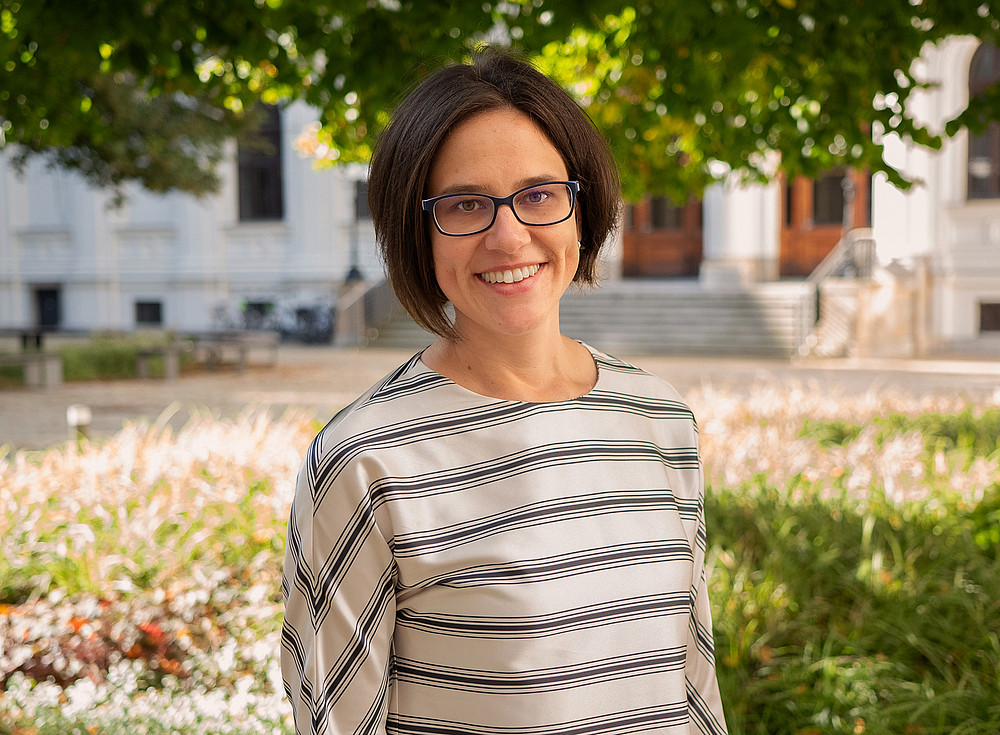
Portrait of Maria Bertel in the courtyard of the main building of the University of Graz

How can, may and should AI be used in schools? Legal expert Maria Bertel has compiled a guide with answers to legal questions on this topic. Photo: University of Graz/Radlinger

The legal expert and her team analysed the legal situation regarding the use of artificial intelligence in education as part of an EU project and answered open questions from practice.

Researching facts, compiling exercise material or even marking homework: there are many areas of application for AI in schools. Which of these are actually permitted? Where are the pitfalls? And what obligations do pupils and teachers have when using ChatGPT & Co.? Lawyer Maria Bertel and her team, supported by research manager Maddalena Vivona, have addressed these questions.

"There are several legal principles that must be taken into account when using AI in education: for example, the EU's AI Act, the General Data Protection Regulation and – something that is rarely considered – children's rights," summarises Maria Bertel from the Institute for Public Law and Political Science. Together with Evelyne Putz and Julian Priebsch, she has combed through the legal situation in the European Union as part of the EU-funded EducationalAI project and summarised the relevant points in a guide for teachers and managers in the education sector. "The AI Act already makes important provisions in this regard. Certain applications, such as assessing performance exclusively through artificial intelligence, are classified as high risk," the researcher clarifies. 

If Copilot, Gemini or other AI systems are used in class or for homework, the protection of personal data must be taken into account. Not everyone is aware of this. The fact that a German teacher can become the operator of an AI system when she sets a research task is hardly obvious without specialist legal knowledge. "So we have clarified many legal terms that teachers are usually not so familiar with," explains Bertel. The lawyers sought the expertise of ethicists, didacticians and educators in order to take into account the needs of everyday practice. The guide, which contains selected EU legal principles, is available for free download.

Together with Evelyne Putz, Maria Bertel is now creating a counterpart that focuses on Austrian law. This is expected to be completed in early summer this year. "We hope that this will help to reduce legal uncertainties surrounding the use of artificial intelligence in schools," says the lawyer. She recommends that individual educational institutions work with young people, parents and management to develop guidelines. The researcher has no doubt that the technology should be used in educational institutions. A chatbot, for example, could be a good learning tutor. However, it is important to accompany the children and make it clear to them that they are communicating with a machine. 

The researcher welcomes Education Minister Christoph Wiederkehr's initiative to introduce AI as a subject in schools: "Digital skills and knowledge about how these tools work should definitely be taught. This applies to all subjects. I don't want to judge whether a new subject needs to be introduced for this purpose."

created by Dagmar Eklaude

Related news

Law from the Machine?

In ancient Greek, apò mēkhanês Theós (more well-known in Latin as "Deus ex machina") describes the way mythological figures appeared in theaters seemingly from thin air, instantly influencing the plot. Today, Artificial Intelligence might exert similar effects in legal proceedings. Students from our faculty are currently taking a deep dive into this matter in a human rights moot court competition, inter alia, in Greece - and they are doing so with great success.

Hello, Fellow: Andromachi Rina

Maritime Law doctoral researcher and EU-qualified lawyer Andromachi Rina joins us as Wirtschaftskammer Steiermark Junior Fellow this March - welcome!

Jetzt Studienplatz sichern!

Klimawandel, Künstliche Intelligenz, Krisen – geh‘ mit uns die richtig großen Themen an! Unsere Welt benötigt Ideen und Lösungen für ihre Herausforderungen – und dich als Jurist:in! Bei uns profitierst du im neuen „REWI Welcome Year“ von optimierten Strukturen für Lehrveranstaltungen und Prüfungen. Und von unserem erprobten Mentoring-Angebot sowieso. So kannst du ohne Verzögerungen studieren und bist breit aufgestellt.

Navigating Standardisation: Human Factor in Digital Transformation PhD School

Research meets European standardisation: From 3–5 and 12–13 February 2026, the HFDT Stand-EUVI PhD School at the University of Graz brought together ten doctoral researchers and post docs from physics, law, human movement sciences, psychology, molecular biosciences, and education economics to reflect on standardisation in line with European values and interests (Stand-EUVI).

Begin of page section:
Additional information:

University of Graz
Universitaetsplatz 3
8010 Graz
Austria
  • Contact
  • Web Editors
  • Moodle
  • UNIGRAZonline
  • Imprint
  • Data Protection Declaration
  • Accessibility Declaration
Weatherstation
Uni Graz

End of this page section. Go to overview of page sections

End of this page section. Go to overview of page sections

Begin of page section:

End of this page section. Go to overview of page sections